Government, Politics, and Civic Engagement
At its core, government, politics, and civic engagement represent how people organize, make decisions, and participate in shaping their communities and nations. It is the framework through which societies address collective needs, resolve differences, and pursue shared goals. Civic engagement specifically refers to the ways individuals take part in public life—through voting, volunteering, advocacy, or simply staying informed about issues that matter. Together, these elements form the foundation of democratic societies and influence everything from local school board decisions to national policy debates.
For many people, understanding this landscape can feel overwhelming. The terminology, processes, and sheer volume of information create barriers to participation. That is precisely why clear, accessible communication tools matter. Whether you are a teacher explaining how a bill becomes law, a nonprofit encouraging voter registration, or a campaign manager building public awareness, visuals help bridge the gap between complex systems and everyday understanding.
What Makes This Icon Set Valuable
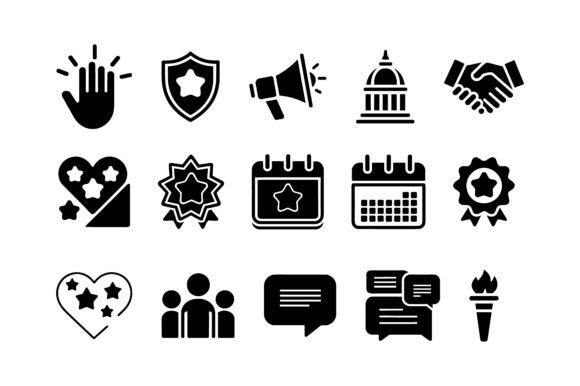
This professional Government, Politics, and Civic Engagement Icon Set brings together a thoughtful collection of silhouettes designed to communicate key ideas instantly. The set includes recognizable symbols such as the Capitol building, a handshake, a debate podium, voting imagery, and activism motifs. These visuals cover a broad spectrum of topics within the civic space, making them useful for a wide range of projects and audiences.
The appeal of this set lies in its versatility and clarity. Icons serve as visual shorthand—they communicate ideas faster than text alone and transcend language barriers. When you need to convey concepts like democracy, collaboration, public service, or citizen action, having a consistent set of professional icons saves time and ensures your message remains coherent across different platforms. The single EPS vector file format also allows for easy scaling and customization, so you can adapt each icon to fit your specific layout or branding requirements.
Who Benefits from Civic Engagement Visuals
Adults between the ages of twenty and fifty represent a broad cross-section of society, and each segment interacts with civic content differently. Beginners exploring how government works for the first time need materials that reduce confusion. Creators and marketers developing content for campaigns or social causes require assets that communicate professionalism and trust. Educators and trainers preparing lesson materials want visuals that clarify abstract concepts without oversimplifying them.
Small business owners and freelancers may find themselves creating presentations for local government contracts or community partnerships. Bloggers and content creators covering political topics need eye-catching graphics that draw readers in while maintaining accuracy. For every one of these scenarios, having a reliable icon set makes the difference between a generic presentation and one that resonates with its audience.
Addressing Common Goals and Challenges
People turn to civic engagement resources for several reasons. Some need to explain how government functions to students or community members who feel disconnected from the process. Others aim to motivate participation—whether that means encouraging voter turnout, recruiting volunteers for a cause, or building awareness around a specific policy issue. Still others work behind the scenes designing materials for government agencies, nonprofits, or political campaigns, where visual consistency and professionalism are non-negotiable.
A common challenge across these scenarios is maintaining audience attention. Civic topics can feel dry or overly complex, especially when presented as blocks of text. Icons help break information into digestible pieces. A timeline of voting milestones becomes more memorable when paired with a ballot box icon. A diagram of government branches is easier to follow when each branch has a distinct visual marker. The right icon set transforms dense information into something approachable without losing accuracy.
Practical Applications Across Contexts
The versatility of this icon set becomes clear when you consider the range of environments where it can be used. Below are several realistic scenarios that illustrate its value.
- Educational presentations. A high school civics teacher preparing a unit on the three branches of government can use the Capitol building icon alongside custom labels to create slides that students actually remember. The handshake icon works well for lessons on diplomacy or international relations.
- Campaign materials. A local candidate running for city council needs flyers, social media graphics, and website elements that communicate trust and action. Voting and activism icons reinforce calls to participate, while the debate icon signals thoughtful discussion of issues.
- Government agency websites. Municipal websites often struggle with usability. Using consistent icons for services like registering to vote, attending public meetings, or contacting representatives helps citizens navigate more efficiently and reduces frustration.
- Nonprofit advocacy reports. Organizations working on issues like voter access or community organizing can use the activism symbols to illustrate progress, challenges, and calls to action in annual reports or grant applications.
- News outlet infographics. Journalists covering elections or legislative processes benefit from icons that quickly orient readers. A debate icon next to a candidate profile or a handshake icon alongside a story about bipartisan cooperation adds immediate context.
Each of these examples shares a common thread: the visuals do not replace substantive content but rather enhance it. They guide the viewer's eye, reinforce key messages, and create a more polished final product.
Important Considerations When Using Icon Sets
While icon sets offer tremendous utility, using them effectively requires some thought. First, consider your audience. Icons that resonate with one group may confuse another. For instance, the Capitol building is widely recognized in the United States but may carry different associations internationally. If your project reaches a global audience, choose symbols that translate across cultural contexts or supplement them with clear labels.
Second, consistency matters. Using icons from the same set ensures that line weights, proportions, and stylistic details match throughout your project. Mixing icon sets from different sources can create visual noise and undermine the professionalism you aim to achieve. The EPS vector format included with this collection makes it straightforward to maintain uniformity because you can scale and modify each icon without losing quality.
Third, avoid overloading your design. Icons work best when they serve as accents or wayfinding elements, not as the primary carrier of information. A single well-placed icon can communicate more than a cluster of competing symbols. Think of each icon as a visual anchor—it should orient the viewer without distracting from the main message.
Getting Started Without Overwhelm
If you are new to working with vector icon sets, the process is more accessible than it may seem. EPS files open in most major design software, including Adobe Illustrator, Affinity Designer, and free alternatives like Inkscape. Once opened, you can select individual icons, change colors, resize them, and export them in the format your project requires—PNG for web use, PDF for print, or SVG for responsive digital design.
Start by identifying the core messages in your project. List the concepts you need to visualize, then match them to the icons available in the set. For a voter education guide, you might prioritize the ballot box and activism symbols. For a government transparency report, the Capitol building and handshake may take center stage. By matching icons to your specific goals, you avoid the temptation to use every available symbol and keep your design focused.
Why This Matters Now
Interest in government and civic engagement fluctuates with election cycles, major legislation, and social movements, but the underlying need for clear communication remains constant. People want to understand how decisions affect their lives and how they can make their voices heard. They also want information presented in ways that respect their time and intelligence. Professional icon sets address both desires by making civic content more navigable and more inviting.
For creators, educators, and professionals working in this space, investing in quality visuals is an investment in your audience's comprehension and trust. When someone can glance at a slide, flyer, or webpage and immediately grasp the structure of your message, you have already won half the battle. The remaining work—delivering substance, context, and actionable information—becomes far more effective when built on a foundation of clear visual communication.
Whether you are designing materials for a school civics unit, preparing campaign literature, or updating a government agency website, this icon set provides the tools to present complex ideas with simplicity and confidence. It helps turn abstract concepts like democracy, collaboration, and civic duty into visuals that speak directly to the people you are trying to reach.