3D Isometric Traveling Pack
Creating travel-themed visuals that feel dynamic and polished can be a challenge—especially when you’re juggling tight deadlines, multiple file formats, or the need for consistent style across a project. The 3D Isometric Traveling Pack addresses that challenge directly by offering a library of ready-to-use, isometric travel objects designed to fit seamlessly into both 3D and 2D workflows. Whether you are building a travel app interface, illustrating a blog post about adventure planning, or assembling promotional graphics for a travel agency, this collection gives you a head start with assets that already look clean, modern, and professionally lit.
Why an isometric approach matters for travel visuals
Isometric design has become a staple in modern digital work because it offers depth and spatial clarity without the complexity of full perspective rendering. The 3D Isometric Traveling Pack takes advantage of this by providing objects that sit naturally together in the same coordinate system—luggage, maps, cameras, transportation elements—so you can build coherent scenes quickly. Instead of spending hours aligning angles or adjusting shadows, you can drop in elements that already share a consistent viewing angle and lighting setup. That consistency matters when you are creating infographics or interface illustrations where every asset needs to feel part of the same world.
For designers who work with isometric scenes regularly, having a dedicated travel pack saves not only time but also mental energy. You are free to focus on composition, color grading, and storytelling rather than modeling each suitcase or taxi from scratch. The result is a more cohesive visual narrative that resonates with audiences looking for clean, approachable design.
File formats that fit your workflow
One of the practical strengths of the 3D Isometric Traveling Pack is the range of file formats included. You get .PNG files with transparent backgrounds, .JPG versions optimized for high resolution, .BLEND files for direct use in Blender, and .OBJ files for importing into other 3D software. This variety means you are not locked into a single pipeline—you can work the way that suits your project. If you are building a quick concept mockup, the transparent PNGs let you composite assets into a scene without any rendering at all. If you need to adjust lighting or texture for a game environment, the Blender source files give you full control over the 3D geometry.
The .OBJ format is particularly useful for cross-platform work. You can bring the assets into Cinema 4D, Maya, or even game engines like Unity and Unreal Engine. That kind of flexibility matters when you are collaborating with a team that uses different tools. Everyone can access the same geometry without conversion headaches, which streamlines feedback loops and keeps production moving.
Marketers and small business owners
If you are producing promotional materials for a travel-related business—whether it is a boutique hotel, a tour operator, or a travel gear brand—the 3D Isometric Traveling Pack can help you create visuals that stand out on social media and landing pages. Isometric illustrations have a distinctive look that holds attention in crowded feeds. You can build a scene showing a camera, map, and suitcase to represent the experience of exploring a new city, then overlay your headline and call-to-action. Because the assets come with transparent backgrounds, you can integrate them into your existing brand assets without spending time on masking or cutouts.
Content creators and bloggers
Travel bloggers often need custom visuals that reflect their personal brand without requiring expensive illustration commissions. With this pack, you can produce original graphics for articles about packing tips, destination guides, or travel gear reviews. For example, you could create a side-by-side comparison of a well-packed suitcase and a disorganized one, or arrange a map and camera next to a key takeaway quote. The isometric style gives your blog a polished, magazine-like feel that builds credibility with readers.
Game developers and app designers
For game developers building travel-themed levels or casual simulation games, the 3D Isometric Traveling Pack offers a solid foundation of props. Luggage, maps, and transportation elements can be placed in waiting areas, airports, or travel hubs to make the environment feel more lived-in. Because the objects are modeled with clean geometry, they render efficiently on mobile devices without sacrificing visual quality. App designers working on travel planning tools can also use the assets to create onboarding screens or feature illustrations that show users how to navigate the app.
What you get inside the collection
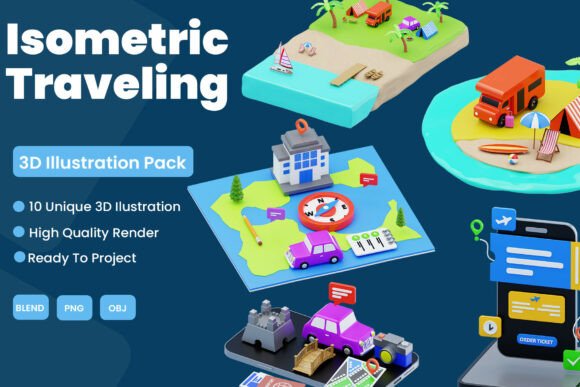
The pack is not a small sample set—it includes a curated selection of travel essentials that cover most common scene requirements. You will find different types of luggage, ranging from suitcases to backpacks, plus navigation tools like folded maps and compasses, along with cameras, tickets, and transportation elements such as buses and taxis. Each object is rendered with attention to detail, including subtle materials and color variations that keep scenes from looking flat. Having this breadth of items means you can assemble a rich scene without needing to pull assets from multiple sources that may not match stylistically.
It is worth noting that the pack is designed to feel vibrant but not cartoonish. The color palette leans toward modern, muted tones with enough saturation to look inviting—making it suitable for both B2B and B2C projects. If your brand uses a specific color scheme, you can recolor the Blender files to align with your identity.
How it supports creativity without restricting it
One common concern with asset packs is that they limit originality—if everyone uses the same suitcase model, how do your visuals stand out? The 3D Isometric Traveling Pack is structured to encourage customization rather than lock you into a fixed look. Because you have access to the original Blender files, you can modify geometry, adjust materials, and combine elements to create new objects. Need a suitcase with a branding sticker? You can add one. Want to turn a bus into a tour vehicle with a different color scheme? That takes minutes in Blender. The pack gives you a starting point that saves you the repetitive modeling work while leaving room for your creative decisions.
For designers who prefer 2D workflows, the transparent PNG files offer a different kind of flexibility. You can layer them with textures, photos, and typography in Photoshop or Illustrator, applying effects and filters that make the isometric objects feel integrated into a flat illustration style. This hybrid approach works well for projects that blend photographic backgrounds with vector-style elements.
Who benefits most from this pack
While the collection is accessible to anyone creating travel-themed visuals, certain professionals will find it especially valuable. Freelance designers and small studios often work with limited budgets and tight timelines—having a ready-to-go asset library reduces the need to subcontract modeling work. Educators and instructional designers can use the pack to build visual aids for geography or travel-related courses without spending hours on graphics. Entrepreneurs launching a travel startup can produce professional-looking pitch decks and website visuals without hiring a dedicated 3D artist.
That said, the pack is not a one-size-fits-all solution. If your project requires highly realistic renders with complex lighting, the isometric style may feel too stylized for your needs. Similarly, if you need very region-specific items—like a particular type of train or a country-specific map—you may need to supplement the pack with custom modeling. It is always a good idea to review the full asset list against your project requirements to ensure the collection covers the items you need most.
Practical tips for getting the most out of the pack
To integrate the 3D Isometric Traveling Pack effectively, start by planning your scene layout on paper or with simple sketches. Decide which objects you need and how they relate to each other spatially. Since all assets share the same isometric grid, you can place them without worrying about perspective mismatches—but you still need to consider depth and occlusion. Use the larger items like buses or large suitcases as anchor points, then fill the scene with smaller details like tickets and cameras for visual interest.
If you are working in Blender, take advantage of the .BLEND file structure to tweak materials. Even small adjustments—like making a suitcase a different color or adding a subtle glow to a map—can make the scene feel more customized. For 2D users, try overlaying the transparent PNGs on a gradient background and adding a soft shadow beneath each object to reinforce the isometric depth. This simple technique helps the assets feel grounded rather than floating.
Finally, consider mixing elements from the pack with your own custom illustrations or icons. The isometric style pairs well with flat design elements, so you can create a visual language that feels both familiar and unique. The pack works as a foundation, not a cage—it supports your workflow without dictating the outcome.
Bringing it all together
The 3D Isometric Traveling Pack earns its place in a designer’s toolkit by solving a real problem: how to create compelling, travel-themed visuals quickly without sacrificing quality. Its combination of multiple file formats, consistent isometric style, and a thoughtful selection of objects gives you a solid starting point for websites, games, illustrations, and promotions. Whether you are a solo freelancer or part of a production team, the pack reduces friction in your workflow and lets you spend more time on the creative decisions that define your project’s voice. For anyone looking to capture the spirit of exploration in their next design, it is a resource worth exploring.